



The Metaphysics of the WAAAGH! Field: A Socio-Mechanical Analysis of Warhammer 40,000: Speed Freeks
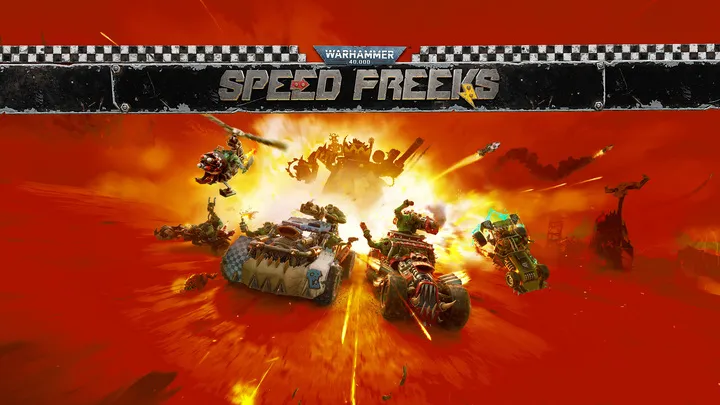
Warhammer 40,000: Speed Freeks represents a singular achievement in translating the irrational, psychic-driven reality of the Ork race into a digital medium. While many see a chaotic combat racer, the game is actually a sophisticated simulation of Orky theology, where the laws of physics are superseded by the collective belief of the Speed Mob. In the 41st Millennium, Orks do not simply drive; they manifest a psychic phenomenon known as the WAAAGH! field, which allows machines made of scrap metal and fungus-fuel to achieve velocities that should, by any standard of Imperial engineering, result in immediate structural failure. This article explores the specific, deep-seated mechanical soul of Speed Freeks, focusing on how the game codifies the Ork obsession with Goin’ Fastah as a tangible, reality-altering force.
To understand the depth of Speed Freeks, one must look past the how-to of drifting and instead examine the why of the machine. The game’s architecture is built upon the concept of the Speed Flick—a psychological state where an Ork’s biological imperative for war is channeled entirely into the pursuit of kinetic energy. This analysis will dissect the socio-mechanical layers of the game, from the religious significance of red paint to the industrial brutalism of its wasteland tracks. We will explore the hierarchy of the Kult of Speed and the Dakka-Velocity feedback loop, illustrating how Speed Freeks is not just a game about racing, but a profound exploration of a species that believes they can outrun their own mortality through sheer, reckless acceleration.
1. The Genesis of the Speed Flick: Neurological Obsession as a Gameplay Loop
The Speed Flick is the specific neurological anomaly that defines every vehicle in Speed Freeks. Within the game’s logic, this is not merely a preference for high speeds, but a biological rewiring of the Ork pilot. The game captures this through its aggressive FOV (Field of View) shifts and the visual distortion that occurs when the Nitro-Boost is engaged. It represents a total rejection of tactical caution in favor of a singular, monomaniacal focus on the horizon. For these Orks, the sound of a revving engine is a choir, and the smell of burning promethium is incense. The game’s engine reflects this by making the environment secondary to the sensation of the Rush, where the player feels the vibration of the virtual chassis as a rhythmic, biological heartbeat.
This obsession manifests in the game through a unique Momentum Multiplier. Unlike other racers where speed is a static stat, in Speed Freeks, your performance improves the more chaos you cause. This is the WAAAGH! in Motion. By damaging enemies or successfully navigating high-risk shortcuts, the Ork pilot’s belief in their own supremacy grows, which in turn fuels the psychic field that powers their engine. It is a feedback loop of adrenaline and scrap metal. The obsession is so potent that it overrides the Ork's natural instinct to stick with their tribe, creating the transient, nomadic warbands that characterize the 16v16 lobbies. They are united not by blood or banner, but by the shared frequency of a thousand mismatched pistons firing in unison.
2. The Theology of Red Paint: Belief as a Physical Friction Coefficient
In the Warhammer 40,000 universe, the Ork belief that Red Ones Go Fastah is a documented psychic phenomenon. Speed Freeks treats this with mechanical reverence rather than as a cosmetic joke. When a player selects a vehicle variant adorned in the crimson of the Evil Sunz, the game’s internal physics engine applies a subtle shift to the acceleration curve. This is the Faith Factor. It isn't that the paint is aerodynamic; it’s that the Ork believes it is, and the WAAAGH! field responds by thinning the air around the vehicle. This creates a fascinating layer where aesthetics directly influence the feel of the handling, bridging the gap between lore and gameplay mechanics.
This theology extends to the very construction of the vehicles. An Ork vehicle in Speed Freeks is a collection of parts that should not work together—engines from Imperial tanks, wheels from civilian tractors, and armor plating from downed aircraft. They function because the Ork pilot views the machine as a living entity. The game’s damage model emphasizes this; parts fly off, engines smoke, and tires wobble, yet the vehicle continues to accelerate. It is a manifestation of Functional Chaos, where the silhouette of the vehicle is jagged and asymmetrical. The player isn't managing a machine; they are maintaining a psychic manifestation of Orky willpower.
3. The Dakka-Velocity Feedback Loop: The Metaphysics of Firepower
In Speed Freeks, firepower (Dakka) and speed (Velocity) are intrinsically linked in a metaphysical cycle. The more Dakka an Ork fires, the faster they feel they are going; conversely, the faster they go, the more Dakka they feel they need to clear the path. This isn't just about clearing enemies; it is about the Noise. The cacophony of twin-linked big shoottas provides a rhythmic cadence to the drive. The game captures this by tying certain speed boosts to successful hits, rewarding the player for maintaining high-volume fire while navigating complex terrain.
This loop creates a specific flow state unique to Speed Freeks. Unlike other racers where you might let off the gas to aim, the Ork pilot is encouraged to do the opposite. The weapons are often fixed-forward or wildly inaccurate, necessitating a spray and pray approach that matches the reckless nature of the driving. It is a mechanical representation of the Ork mindset: if you aren't shooting, you aren't winning, and if you aren't winning, you aren't going fast enough.
The Components of Dakka-Velocity
- Rhythmic Discharge: Auditory feedback that syncs with engine RPM.
- Kinetic Recoil: Heavy cannons that push the vehicle back, requiring more nitro to compensate.
- Psychic Tracers: Weapon fire that illuminates the optimal path through the wasteland.
4. Brutalist Architecture of the Wasteland: The Track as a Sacrificial Altar
The tracks in Speed Freeks, such as Dakka Canyon and the Badlands, are not designed for racing; they are designed for attrition. They represent the Orky terraforming of Imperial worlds—stripping the planet of its resources and leaving behind a jagged, industrial skeleton. The architecture is brutalist, characterized by massive rusted cranes, open pits of toxic sludge, and jagged rock formations. These tracks act as a sacrificial altar where the weak are culled, and only the fastest and kunnigist survive to reach the next waypoint.
Environmental hazards in the game are not mere obstacles; they are tests of faith. The Mega-Blades and Squig-Pits are designed to punish those who hesitate. In the mind of a Speed Freek, a narrow bridge over an acid pool is not a danger—it is a challenge to see who can cross it with the most flash. The tracks are littered with the husks of previous racers, serving as a constant reminder that the wasteland is an indifferent God that demands constant offerings of scrap and blood.
5. The Hierarchy of the Kult of Speed: Rank Through Mechanical Excess
Within the 16v16 ecosystem of Speed Freeks, a hierarchy emerges based on mechanical excess. This is not a traditional military structure but a social order based on who has the loudest engine and the most Dakka. The Warbosses of the Speed Mob are those who lead the Kill Konvoy, their vehicles acting as mobile fortresses that dictate the flow of the battle. Below them are the Nobs and Boyz, who act as outriders, their worth measured by their ability to harass the enemy and secure objectives without slowing down.
This hierarchy is reflected in the game’s vehicle classes. The heavier Kustom Boosta-blastas and Rukkatrukk Squigbuggies occupy the top of the social ladder due to their massive size and firepower. The lighter Shokk-jump Dragstas and Killa Wartrikes are the restless outriders, constantly vying for position. This creates a dynamic where players aren't just competing against the enemy; they are competing for status within their own mob. To be the first to reach the Stompa is to be the greatest Ork in the eyes of Gork and Mork.
6. Fungal Fuel and Scrap Spirits: The Internal Biology of the Machine
One of the deepest topics in Speed Freeks is the implied biology of the vehicles. Because Orks are fungal organisms, their technology often shares a symbiotic relationship with their biology. The engines are not purely mechanical; they are fed by fungal distillates and maintained by Grot-riggers who live within the chassis. In the game, this is reflected in the way vehicles recover from damage. There is a sense of organic resilience—a vehicle can be burning and missing wheels, yet it still screams across the desert.
This "Scrap Spirit" is what allows the vehicles to perform impossible maneuvers. The way a heavy tank can drift through a tight corner in Speed Freeks defies standard physics, but it makes perfect sense within the context of Orky engineering. The vehicle responds to the pilot’s intent more than its own mechanical limitations. This creates a tactile, heavy feel to the driving that is simultaneously floaty and unpredictable, mimicking the unstable nature of the machines themselves.
7. The Deff Rally as a Religious Pilgrimage
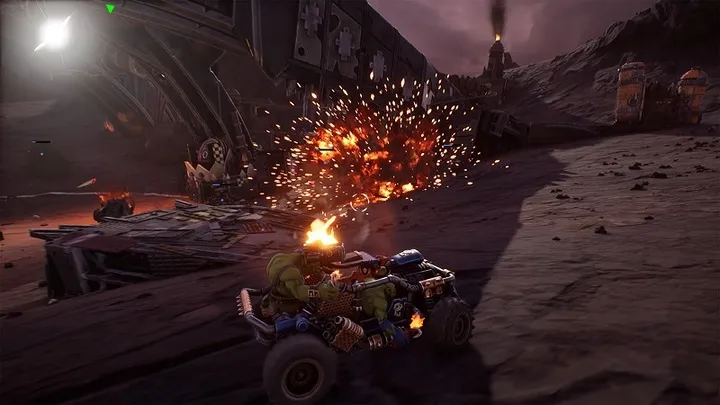
The Deff Rally mode is more than a race; it is a religious pilgrimage through the wasteland. Every waypoint represents a milestone in the Ork’s journey toward total kinetic enlightenment. The waypoints in Speed Freeks are often placed in the most dangerous locations possible, forcing the Mob to congregate in "Kill Zones" where the carnage is densest. This is intentional; an Ork does not want a clean race. They want a struggle that proves their machine is favored by the gods.
The "Energy Hubs" at these waypoints provide a temporary speed boost, which can be seen as a divine blessing. The first Ork to reach the hub receives the greatest boost, creating a desperate, violent scramble for the lead. This mode perfectly encapsulates the "Speed Freek" philosophy: life is a series of checkpoints, and the only sin is being the last one to reach them. The rally is a cycle of destruction and rebirth, where the scrap of the fallen is used to fuel the fire of the survivors.
8. The Kill Konvoy: Protecting the Mechanical God
The Great Stompa is the centerpiece of the Kill Konvoy mode, acting as a walking cathedral of the WAAAGH!. Its presence on the battlefield fundamentally alters the behavior of the Speed Mob. In this mode, the vehicles are no longer just racers; they are acolytes protecting their mechanical god. The Stompa provides a massive psychic aura that empowers nearby Orks, increasing their Dakka and speed. This creates a unique tactical environment where the "Gravity" of the Stompa pulls the entire 16v16 conflict into its wake.
Protecting the Stompa is a communal act of faith. Orks will throw their vehicles into the path of incoming rockets to save their god-machine, not out of a sense of duty, but because the Stompa’s destruction would mean the end of the WAAAGH!. The interaction between the smaller vehicles and the massive Stompa highlights the scale of Ork ambition. They aren't just trying to win a war; they are trying to keep a god walking through a landscape of total annihilation.
9. The Aesthetic of Functional Chaos: Salvage as a Design Philosophy
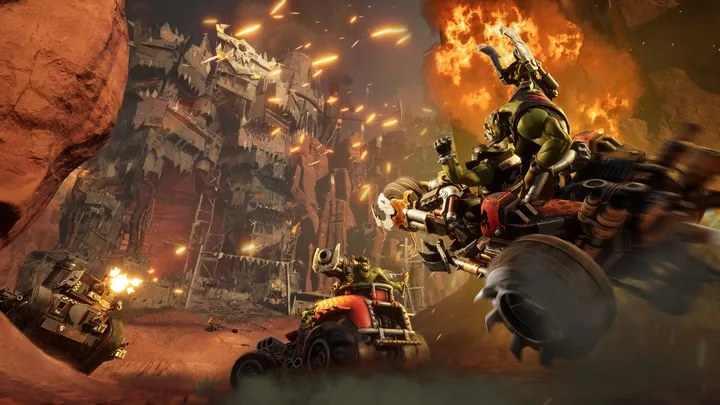
The visual language of Speed Freeks is rooted in the aesthetic of salvage. Every vehicle is a patchwork quilt of stolen technology. This design philosophy is deeply tied to the Ork concept of "Lootin’." In the game, your vehicle's appearance is a record of your clan’s history. A Shokk-jump Dragsta might have the spoiler of a downed Aeldari fighter or the exhaust pipes of an Imperial Chimera. This isn't just decoration; it is a display of dominance over other races’ technology.
This "Functional Chaos" extends to the UI and HUD elements. They are clunky, analog, and frequently glitchy, reflecting the unreliable nature of Ork tech. The player is forced to navigate through a screen filled with shaking gauges and oil splatters. This immersion reinforces the idea that you are piloting something that is constantly on the verge of exploding. The beauty of Speed Freeks lies in this ugliness—a celebration of the discarded and the broken, repurposed for the pursuit of glory.
10. The Heat-Death of the Engine: The Finality of the Great Push
The final phase of any engagement in Speed Freeks represents the "Heat-Death" of the machine. As the race nears its conclusion and the Konvoys clash, the machines are pushed past their breaking points. The game’s heat-management mechanics become the central focus. Every weapon fire and every nitro burst adds to the thermal load of the engine. This is the moment where the Speed Freek must decide between caution and a glorious, fiery end.
At this stage, the individual pilot’s obsession reaches its zenith. They are no longer racing for waypoints; they are racing toward a final, violent conclusion. The Stompa provides a focal point for the final psychic surge, magnifying the speed and power of every vehicle for one last push. It is a beautiful, terrifying end to the Speed Flick—a moment of pure, unadulterated chaos where the engine finally gives out, the fuel tank ignites, and the Ork pilot achieves a state of Eternal Velocity in the Great Green beyond.
Conclusion
Warhammer 40,000: Speed Freeks is a profound exploration of the Ork psyche, manifesting as a combat racer where belief, noise, and velocity intersect. It is a game that honors the Kultur of the Kult of Speed by making every gear shift and every Dakka burst feel like a religious act. Through its unique physics, theological color palettes, and brutalist environmental design, it captures the essence of a race that lives for the Rush. To be a Speed Freek is to embrace the paradox of the machine: that it is most alive when it is on the verge of total annihilation. Now, paint it red, hold down the trigger, and join the WAAAGH!—because the only thing better than going fast is going fastah.