.webp)







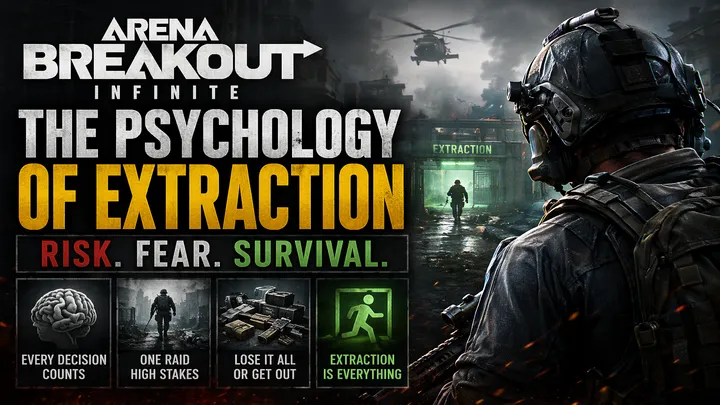
In most shooters, the core loop is simple: engage, eliminate, repeat. But Arena Breakout Infinite operates on a fundamentally different psychological axis—one where the act of leaving matters more than the act of fighting. This article examines a specific and deeply layered topic: the psychology of extraction and risk valuation across a single raid.
Unlike traditional FPS systems, where death is merely a reset, Arena Breakout Infinite enforces persistent loss. Gear, currency, and progress can vanish instantly if extraction fails. This transforms every decision into a complex negotiation between fear and ambition. What emerges is not just gameplay, but a behavioral model shaped by uncertainty, loss aversion, and escalating tension over time.
1. Pre-Raid Cognition: The Weight of What You Bring
Before entering a raid, players engage in a silent negotiation: what is worth risking? The loadout screen becomes a psychological checkpoint where value perception outweighs mechanical confidence. High-tier gear offers advantages, but simultaneously increases emotional pressure.
This phase closely mirrors loss aversion. Players tend to overestimate the pain of losing equipment compared to the potential gain from a successful raid. As a result, many deliberately under-equip—not because it is optimal, but because it feels safer.
Loadout Anxiety Factors
- Monetary value of gear
- Rarity of equipment
- Emotional attachment to past wins or losses
Emergent Behavior
Players often construct “disposable kits”—loadouts designed to minimize emotional loss. These kits are not about efficiency, but about reducing psychological exposure.
2. Spawn Phase: Immediate Threat Projection
The first seconds after spawning are dominated by anticipation rather than action. Players project invisible threats based on map knowledge, imagining enemy movement patterns before any actual contact occurs.
Because spawn points are structured to create early tension, players instinctively assume nearby opponents. This leads to preemptive positioning decisions driven by fear rather than evidence.
Cognitive Load at Spawn
- Predicting enemy spawn locations
- Choosing aggression versus avoidance
- Interpreting early sound cues
Key Insight
Most early eliminations are not due to poor aim, but incorrect mental models of unseen enemies.

3. Early Raid Movement: The Illusion of Control
Once movement begins, players often feel a temporary sense of control. Routes appear safe, early loot reinforces confidence, and the absence of conflict creates a false sense of security.
However, the environment is inherently unstable. Every space is shared with unpredictable actors—both AI and human. The lack of complete information guarantees that perceived safety is always fragile.
Common Movement Archetypes
- Edge navigation (avoiding central zones)
- Aggressive routing toward high-value areas
- Slow, stealth-based looting paths
Underlying Mechanism
Survival in early minutes is often misinterpreted as skill, when it may simply reflect a lack of encounter.
4. First Contact: Fear vs. Opportunity
The first engagement is a psychological turning point. A victory boosts confidence but also introduces a new problem: increased stakes. Defeat or near-death, on the other hand, immediately shifts behavior toward caution.
Winning a fight paradoxically increases stress. With more loot acquired, the player now has more to lose, which often reduces willingness to engage again.
Post-Combat Decision Tree
- Continue pushing for more loot
- Withdraw and reposition
- Hold position and gather information
Key Observation
Combat is not the peak moment—it is the pivot from ambition to preservation.
5. Loot Accumulation: The Escalation Curve
As inventory fills, every decision becomes more deliberate. The limited carrying capacity forces prioritization, turning items into relative value judgments rather than absolute gains.
This phase introduces escalation bias. The more a player accumulates, the more they fear losing it, which can lead to overly cautious or irrational behavior.
Loot-Based Behavior Shifts
- Decreased willingness to engage
- Heightened sensitivity to sound
- Preference for safer routes
Psychological Threshold
There is a clear tipping point where a player stops acting like a hunter and starts behaving like a survivor.

6. Mid-Raid Paranoia: The Invisible Enemy
At this stage, fear is no longer tied to visible threats. Players begin reacting to possibilities rather than realities. Every sound, every open door, every moment of silence becomes meaningful.
This is where the game’s psychological depth becomes most apparent. The absence of information creates tension more effectively than direct confrontation.
Paranoia Triggers
- Distant or unexplained gunfire
- Signs of prior player activity
- Sudden environmental silence
Behavioral Outcome
Movement slows dramatically. Players prioritize information gathering over progression.
7. Route to Extraction: The Longest Journey
Heading toward extraction introduces a new layer of stress. Players must navigate known danger zones while carrying maximum value, often under time pressure.
Extraction points are not always straightforward. Conditional exits and predictable routes increase vulnerability, particularly to ambushes.
Extraction Risks
- Enemy players waiting near exits
- Limited or conditional extraction options
- Increasing urgency as time runs out
Critical Insight
The closer a player gets to success, the more fragile that success feels.
8. The Extraction Moment: Relief or Collapse
The final seconds before extraction are often the most intense. Players become hyper-aware of their surroundings, anticipating threats even in silence.
A successful extraction delivers not only material rewards but emotional release. Failure at this stage, however, amplifies frustration due to proximity to success.
Outcome States
- Successful extraction → relief and reinforcement
- Failure near extraction → amplified frustration
Emotional Impact
Loss feels significantly worse when it occurs at the edge of success.
9. Post-Raid Reflection: Rationalization and Memory
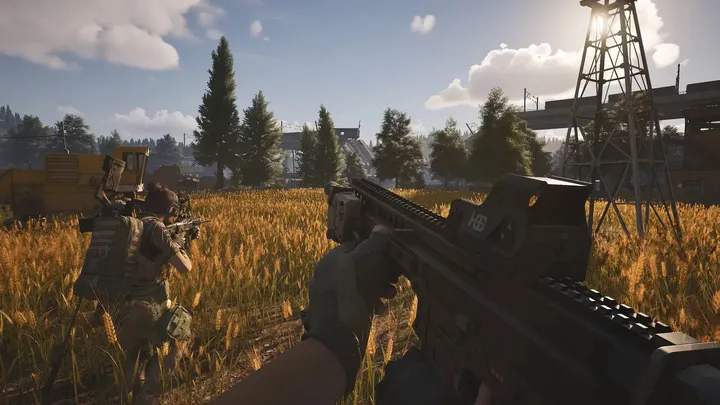
After the raid ends, players reconstruct their decisions. Success is often attributed to skill, while failure is rationalized through external factors.
This reflection process shapes future behavior. Players reinforce patterns—whether effective or flawed—based on subjective interpretation.
Reflection Patterns
- “I should have left earlier”
- “I got too greedy”
- “That situation was unavoidable”
Long-Term Effect
Over time, players develop distinct identities: cautious, aggressive, or opportunistic.
10. Meta Psychology: The Culture of Risk
Beyond individual raids, a broader culture of risk emerges within the player base. Shared terms and playstyles reflect collective understanding of the game’s psychological demands.
The core objective shifts from domination to survival. Success is no longer measured by kills, but by consistent extraction.
Community Archetypes
- The Investor (high risk, high reward)
- The Survivor (low risk, consistent gains)
- The Predator (combat-focused)
Final Observation
Arena Breakout Infinite is not fundamentally about shooting—it is about managing fear, uncertainty, and value under pressure.
Conclusion
Arena Breakout Infinite transforms a familiar genre into a psychological system centered on risk and consequence. Every phase of a raid forces players to confront their tolerance for loss and their ability to act under uncertainty. The game’s true depth lies not in its mechanics alone, but in how it reshapes decision-making. Survival is not just a result—it is a mindset refined through tension, failure, and adaptation.